Outer-case identification
Direct case printing vs print-and-apply labels
Choose direct inkjet or an applied label from the case surface, print content, barcode requirement, changeover and logistics process.
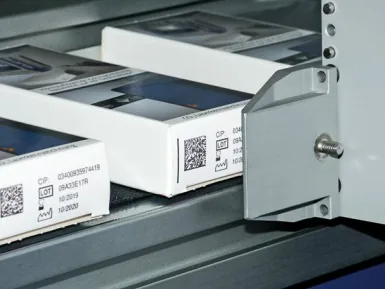
Choose direct inkjet or an applied label from the case surface, print content, barcode requirement, changeover and logistics process.
Large-character inkjet can print variable text, graphics and selected machine-readable codes directly onto suitable board. Print-and-apply produces a label carrying the required information and applies it to the case. The correct choice depends on the carton surface, data density, barcode quality, number of faces and how the case is handled through the warehouse.
| Factor | Direct case printing | Print-and-apply label |
|---|---|---|
| Surface | Best where the case face and ink produce consistent contrast and absorption. | Creates a controlled label background on varied case colours or surfaces. |
| Data density | Strong for large text, product ID, batch, handling marks and suitable barcodes. | Strong for dense logistics labels, multiple fields and standardised layouts. |
| Consumables | Ink; no label backing waste. | Labels and ribbon or direct-thermal media, plus backing waste where applicable. |
| Changeover | Electronic message plus head and case-guide adjustments. | Electronic label format plus label roll, ribbon, applicator and pack adjustments. |
| Application risk | Board porosity, colour, dust, print gap and wet ink contact. | Label adhesion, apply position, tamp or wipe motion and label-present confirmation. |
| Multiple faces | May require more printheads or controlled case rotation. | May require corner-wrap or multiple applicators depending on label position. |
Run trials across the actual case suppliers, recycled-content variation, dust and normal compression or rub after printing.
Confirm label material, adhesive, applicator method, product tracking, label-present detection and reject or stop behaviour.
Both routes need a reliable link between the product or order and the case. Define how the case identity is created, when the job changes and how mixed product or rework is controlled.
Use an upstream product code, case pack count, order or scanner input to select the correct message.
Check print or label presence, readable data and any barcode or 2D symbol, then match the result to the physical case.
Define what happens on no print, no label, low consumable, applicator fault, unreadable code or reject not confirmed.
Where a logistics or corner label is required, review the Lancing print-and-apply labelling system alongside the large-character inkjet option. Final specification depends on the case, label, data and application position.
Send case samples, label or print artwork, line speed and logistics data requirements.
Compare case identification routes