Confirm the existing conveyor is suitable
The belt must expose the code panel, keep the product stable and provide room for the sensor, encoder and bracket. Record speed range, belt direction, working height, guide positions and nearby guarding.
A sensor-triggered thermal inkjet system designed to add variable batch and date coding to an existing conveyor or labelling line.
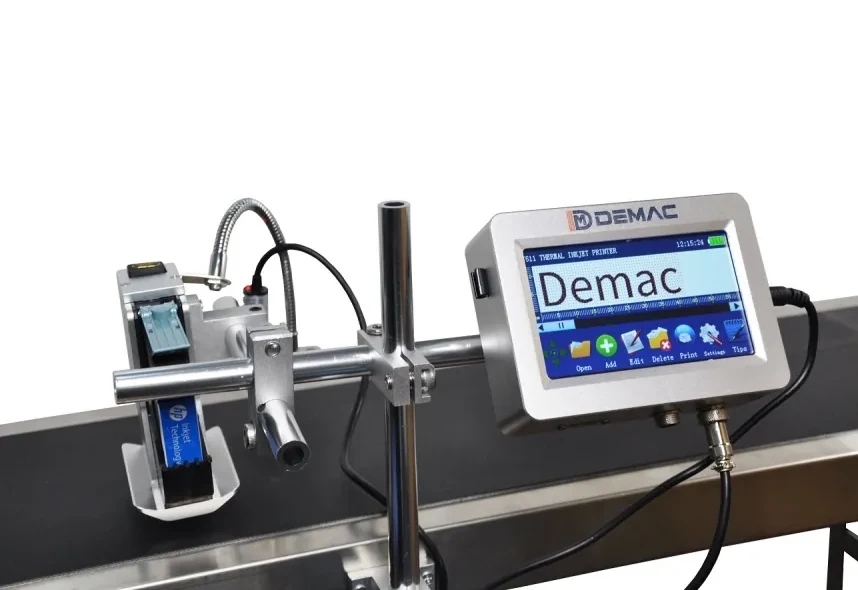
The LU-IIP600-B is specified where an existing conveyor already presents a suitable pack face and only the variable code needs to be added. The reference configuration includes a touchscreen controller, 12.7 mm printhead, product sensor, encoder and adjustable mounting assembly.
| Technology | Bolt-on thermal inkjet |
|---|---|
| Printhead | 12.7 mm reference head |
| Print height | Approximately 2–12.7 mm per printhead |
| Reference print distance | Typically 2–5 mm |
| Triggering | Photoelectric sensor with encoder speed compensation |
| Utilities | 230 V, 50 Hz single phase; no compressed air for the standard coder |
Specification basis: current Lancing quotation and application data. Approximate and reference figures are configuration-dependent and must be confirmed in the written quotation and sample trial.
Use the table to prepare a technically comparable enquiry. The final machine, printhead, ink, mounting and controls are confirmed for the actual product and line.
| Model / configuration | Lancing LU-IIP600-B automatic bolt-on thermal-inkjet coder. A separate conveyor can be engineered where the existing line is unsuitable. |
|---|---|
| Application | Sensor-triggered coding of suitably presented flat packs, labels or cartons downstream of an existing process. |
| Print content | Batch numbers, best-before/use-by dates, text, serial data and approved 1D/2D codes where required. |
| Print height | Approximately 2–12.7 mm per printhead; final line count and layout are subject to sample approval. |
| Print distance | Typically 2–5 mm between printhead and coding surface. |
| Ink / substrate | A cartridge is selected for the approved surface; adhesion and drying must be confirmed by sample trial. |
| Detection | Photoelectric product sensor detects the pack and starts the programmed delay to align the code. |
| Speed compensation | Line encoder provides movement information where conveyor speed varies. |
| Coder utilities | 230 V, 50 Hz single-phase supply; no compressed air is required for the standard coder. |
| Mounting | Adjustable stand and bracket for printhead height, angle and print-gap control. |
| Optional conveyor route | A separate powered conveyor can be supplied with agreed length, belt width, working height, guides, variable speed and emergency-stop controls. |
| Acceptance | Verify code content, position, contrast, adhesion, sensor delay, speed compensation and first-good-pack result after job or cartridge changes. |
The belt must expose the code panel, keep the product stable and provide room for the sensor, encoder and bracket. Record speed range, belt direction, working height, guide positions and nearby guarding.
A pre-printed label or carton should leave enough clear area for the longest approved message. Confirm the label coating, flatness, colour and any varnish that can affect drying or contrast.
Store the approved layout, restrict editing where necessary and require a first-off check after batch changes, power cycles, cartridge changes or mechanical adjustment.
Send representative packs and the longest production message.
Include the line speed, product pitch, coding position, environment, inspection requirement and a short line video.
Yes, provided the existing conveyor offers a stable product path, suitable coding face, safe mounting space and accessible electrical supply. Lancing should review line photographs, dimensions and a production video.
The encoder measures conveyor movement so character spacing can follow changes in line speed. The photocell still detects the product and starts the print delay.
The standard thermal-inkjet coder reference does not require compressed air. Any optional reject device, gate or surrounding machinery may have separate utility requirements.
Yes, that is a relevant application when the label is presented flat and consistently. The reserved panel, coating, ink, code size and line speed must be confirmed from production samples.
For a written model recommendation, provide the product, pack, code, output and installation details.
Request a coding quotation